special offers
How do HVAC systems work?
Whether you have owned your home for 1 or 25 years, you might find yourself wondering, “How does a HVAC system really work?”. HVAC systems are actually fairly simple. They move heat around with fans using Refrigerant, and/or flames to heat or cool the air inside your house. They do this by using an evaporator coil and a condenser,which then blows air over the coils to remove or add heat from the air.
What “HVAC” really means
Everyone has heard of the acronym HVAC, but do you know what it stands for? The term refers to Heating, Ventilation, and Air Conditioning. You probably guessed both heat and air conditioning, but ventilation is often overlooked, even though it is just as important. In practice, when you talk about HVAC, you are referring to the system that keeps the air inside your home or any other building comfortable and safe.
There are a few types of HVAC systems, but they all use the same basic cooling cycle and components.
The Fundamentals: Now, let’s dive into each component of the HVAC system and how it works.
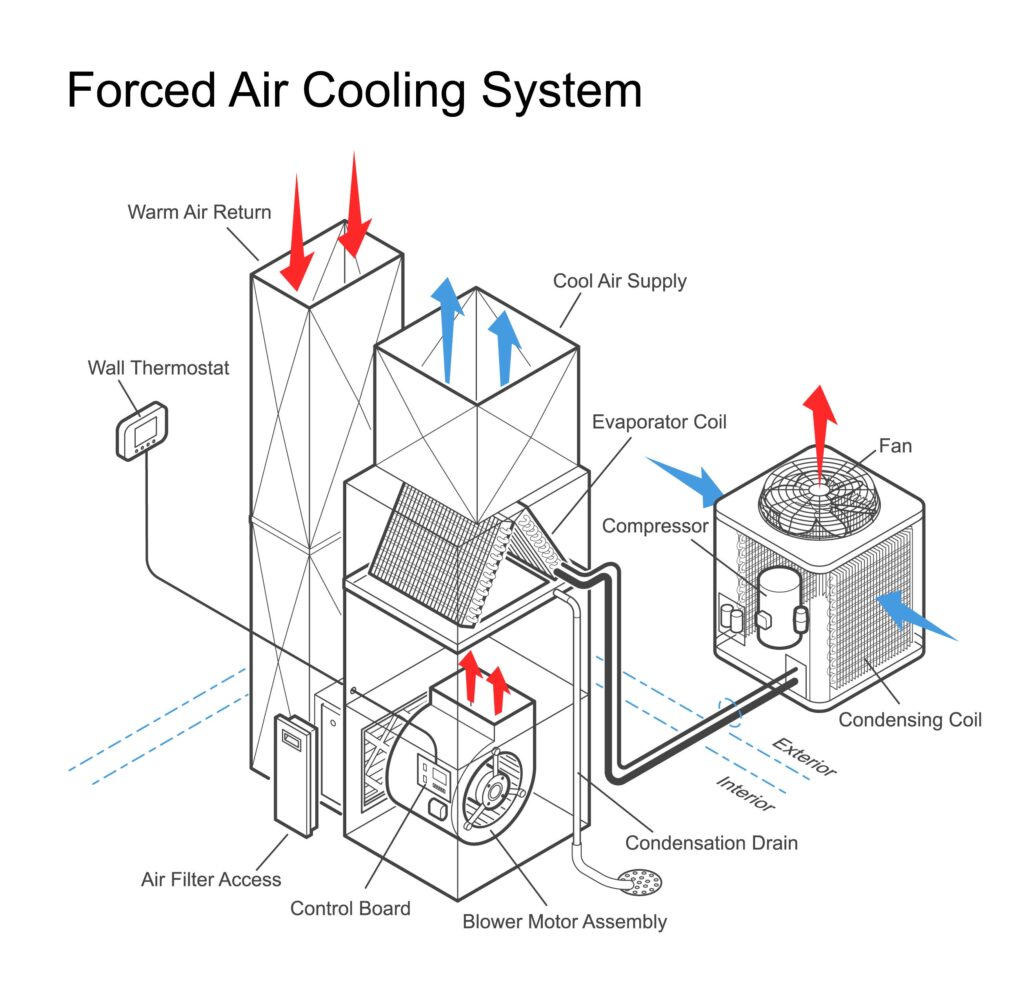
- Thermostat- Probably the most recognizable part of your HVAC system. The thermostat detects the temperature inside your home and then tells your heating or cooling system to turn on to the desired temperature.
- Blower Motor- The blower motor is the air engine of your home. It keeps the air circulating through your ducts and over the coils that add or remove heat from the air.
- Ductwork- The series of channels that distribute the conditioned air through the different areas/rooms of the house and return the air to the system.
- Evaporator Coil- A component that stays cool and collects the heat and moisture from the air.
- Condenser Coil – The condenser coil takes the captured heat inside and releases it outside.
- Refrigerant- A liquid that moves through the system and changes from a liquid to a gas as it absorbs and releases heat.
- Air handlers- part of the unit that houses the blower, air filters, and evaporator coil/furnace, and moves the air through the system to condition and clean it.
- Compressor – The engine of the system; it raises the refrigerant’s pressure so it continues to move through the lines and absorb heat.
- Metering Device – Reduces the refrigerant pressure and temperature before it enters the evaporator coil.
Different Kinds of AC Systems
Package Units: It’s the whole package (see what I did there). Package Units include all the components needed to heat and cool your home. They are great for saving space and are usually installed on a home’s roof or ground. Since everything is together, there is no need to run refrigeration lines, and there are a variety of heating options to suit your needs (heat pump or furnace).
Split System: This is what most people think of when they think of AC, where the unit is split into two parts. There is the condenser and compressor unit outside, and the air handler cabinet inside. A Split System uses refrigeration lines to move the refrigerant to the different units and the ductwork to distribute the cool and warm air throughout the home.
Mini Splits: Mini splits are highly efficient ductless systems that keep your home cool and keep it warm using a heat pump. Instead of ducts, they have a head in each room or section of your home, connected to an outdoor condenser. The advantage is that you can pick exactly which rooms to heat and cool, without having to install ductwork.
What is the cooling cycle?
Now that we know all the components and different kinds of systems, let’s talk about how they work together. When cooling a house, it’s essential to talk about how it’s cooled. The system is not exactly cooling your home; it is removing heat from the air inside your home and sending it away. How does that work? Well, it’s done by using the refrigerant and running it through different parts of the system. When the refrigerant is inside, it starts as a low-pressure liquid, and the blower motor in the air handler pulls air from your home’s intake ducts and passes it over the evaporator coil. The refrigerant then absorbs heat from the air, which turns it into a gas. Similar to boiling water on the stove. The refrigerant is then run outside through the lines to the compressor, where it is pressurized and moves into the condenser as a high-pressure and high-temperature vapor. Then the heat is released to the outside air by the condenser. This cycle repeats itself, with the compressor keeping pressure and the metering device lowering the pressure before the evaporator coil. The AC turns off when the home reaches the thermostat’s set temperature.
Pro Tip: Make sure the sealants on your windows and doors are nice and tight. Your AC is one of the largest energy users in your home. It can save you money to keep as much cold air in as possible.
How do you heat your home?
When it comes to heating your home, things can differ. There are several ways to heat your home. The two main categories are Heat Pumps and Furnaces.
Heat Pumps: Heat pumps work by running the refrigerant in reverse, using a reversing valve to change the direction of the refrigerant flow through the system. This means that instead of removing heat from the inside air and discharging it outside, the system takes heat from the outside and releases it inside your home. The downside is that if you live somewhere that gets cold, there is less heat to pull from the outside air, and the heat pump might not be able to heat the house to the desired temperature. If you still want to use a heat pump but you don’t want to get cold, there is a solution. Heat strips are an additional source of heat that goes inside the air handler and help raise the temperature so that you can stay cozy and warm even in colder weather. They are not very energy efficient, so if it ‘s cold often, you might see your electric bill rise. Also, they require a 240V outlet, so it is vital that your electrical panel is up to date or has room for a new circuit.
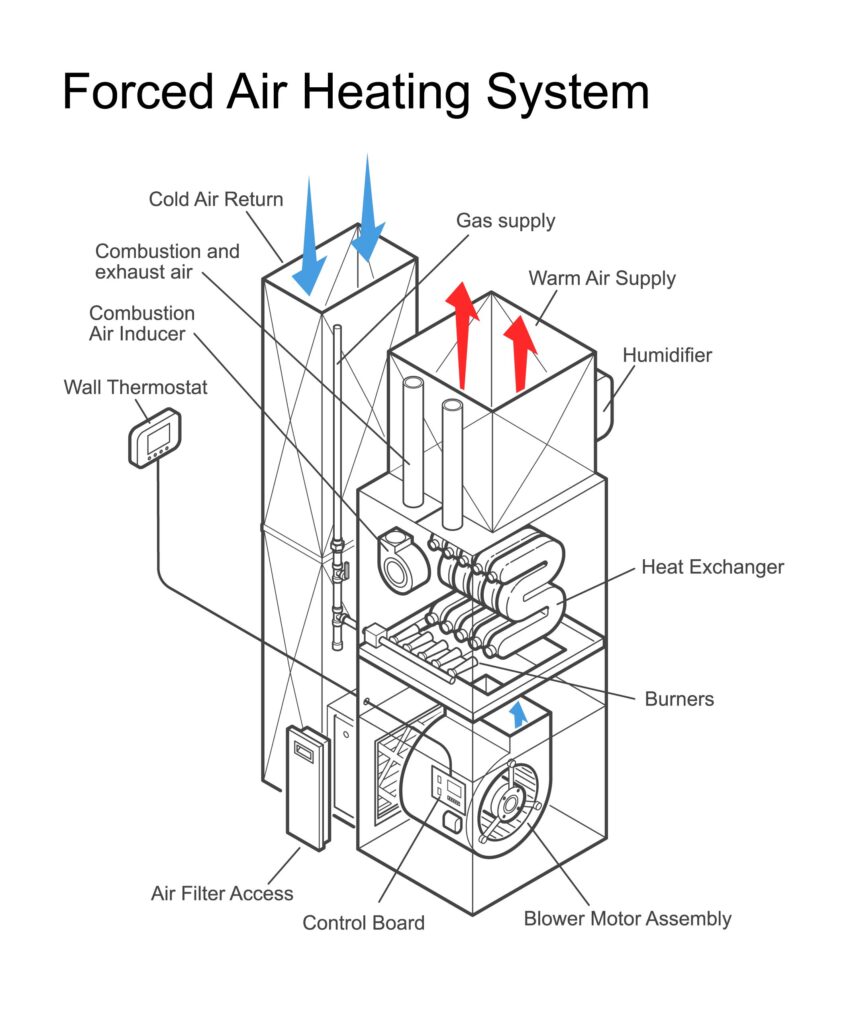
Furnaces (Forced Air): Furnaces are what most people are used to. They heat the air by burning gas, most commonly natural gas. They work by using the blower and ductwork to pull cold air from inside your home. Instead of using Refrigerant, they burn gas in a heat exchanger to heat the air. The hot air is then distributed throughout your home using ductwork. A furnace doesn’t have the same issues in cold weather as a heat pump, since it uses combustible fuel to heat the air.
We can’t forget ventilation: An often-overlooked part of HVAC. Ventilation is bringing in fresh air and exhausting bad air. It keeps the air inside your house fresh by letting in outside air. The exhaust works to remove bad air. Think of bathroom fans, kitchen hoods, or even dryer vents.
Maintenance and when to replace.
To keep your systems up and running, we recommend taking care of them by doing a few things.
- Change your filters every 2 months.
- Check the outdoor unit for debris regularly and keep it clear.
- Seasonal professional tuneups (we know a guy)
- Change your thermostat batteries.
Or if you want to replace your air conditioner, we can help you with that too. Air conditioners installation prices can vary based on a variety of factors, but all you need is for someone from TLC to come out, and we can quote you. NO SWEAT.
That’s it, now you know how your home’s HVAC system keeps you cool in the summer and warm in the winter. It’s really not as complicated as you might think, but if you start to suspect you have any leaks or smell gas in your house, call the professionals. We have a licensed HVAC tech ready to help you out instead of doing this yourself. It can be dangerous if you don’t know what you are doing. Or if it’s time to upgrade, give us a call (505) 761-9644 or schedule online, and we can help you out. NO SWEAT.